The Backbone of Successful Scale-Ups: Baker's Dozen Part 3
Welcome to the third installment in our Baker’s Dozen series, where we translate insights from twelve first-of-a-kind (FOAK) projects into a practical guide for scaling sustainable technologies.
In the first post, we showed how data across 12 projects revealed a clear trend: the more best practices applied, the better the outcomes. The second installment explored how the most successful projects lay strong foundations before construction begins through Chartering, Roadmapping, and keeping the real customer in focus.
This chapter dives into Design & Development, the stage where readiness is assessed, future needs are anticipated, and detailed engineering begins to take shape. It’s where ideas meet drawings, budgets meet constraints, and (if done well) your FOAK project evolves from concept to something that can actually be built and adapted.
Understanding Your Readiness
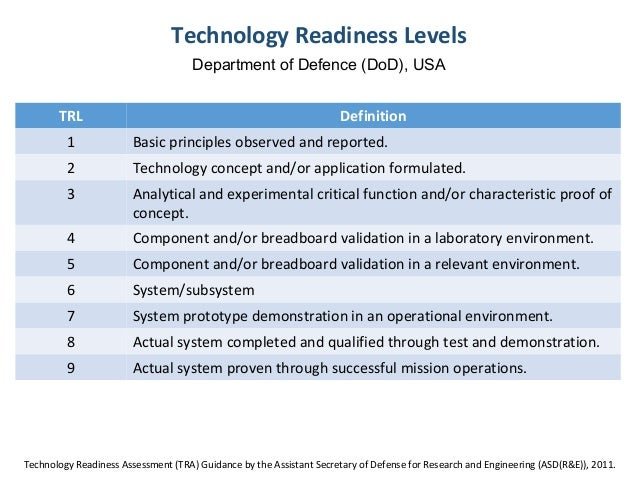
Every successful scale-up starts with an honest look at where the technology stands. Assessing readiness isn’t a box to check. It’s the process of finding out how close your technology is to real-world operation, and where the gaps still live.
That’s where Technology Readiness Levels (TRLs) and Manufacturing Readiness Levels (MRLs) come in. TRLs, originally developed by NASA and now used across the Department of Energy and industrial biotech, measure how mature a technology is from TRL 1 (basic principles observed) to TRL 9 (actual system proven in an operational environment).
MRLs, meanwhile, apply the same concept to the production side: how prepared your manufacturing and supply chain are to deliver consistently.
Together, TRL & MRL form a structured way to answer the most important scaling questions:
What is proven, and what still needs validation?
What happens to your process when you move from lab-scale to pilot-scale (and beyond)?
Where might waste, recycle loops, or bottlenecks emerge under continuous operation?
In a mycelium-based material pilot we supported, applying the TRL framework early helped the team identify a hidden gap between their bench and pilot data, a small issue that could have ballooned into a full re-design later on.
By using readiness tools alongside a clear charter and well-scoped FEL-1 study, the project scaled from a 6,000-liter pilot to a 145,000-square-foot facility while staying within 5% of the target budget.
Across our data set, projects that consistently used TRL and MRL frameworks scored almost 20% higher on overall outcomes compared to those that didn’t. The takeaway is that you should treat readiness as an ongoing discipline, not a milestone. It’s how you catch surprises before they become setbacks.
Day 1 and Year 2 Design: Avoiding Single-Point Failures
Once you’ve assessed readiness, it’s time to design, but not just for the version of your technology that exists today. The most successful FOAK projects are built with Day 1 and Year 2 in mind.
That means balancing immediate needs (get the pilot up and running) with future flexibility (don’t box yourself out of your next evolution). Designing too narrowly risks single-point failures (that moment when one design assumption breaks, and suddenly your entire system does too).
We often guide teams through a series of grounding questions before any steel gets ordered:

In one cultivated meat pilot we developed, the facility was designed to accommodate the current process while leaving both physical and technical space for higher cell densities and improved media formulations in the future. By including that flexibility in our engineering designs early on, the client avoided the trap of retrofitting a rigid pilot and instead built a platform for iteration.
So what can we learn from this? Every FOAK design decision should account for change. Flexibility is insurance for innovation.
Conceptual Design: When to pick the right site?
If readiness tells you what you can build and design tells you how, the Front-End Loading (FEL) stages tell you when to make which decisions.
FEL is the structured, stage-gated process that guides a project from early scoping through detailed design and execution. Each FEL stage builds confidence, refines risk, and prevents overcommitting too early, which is something we see all the time in FOAK ventures eager to “lock in” a site before the process itself is ready.
FEL 0/1: Define scope, create the first conceptual process models, and identify key unknowns.
FEL 2: Refine process design, map utilities and infrastructure, and start budgeting with ±30% accuracy.
FEL 3: Move into detailed design, procurement, and construction planning with clear technical specifications.
In a recent alternative protein project we supported, the client followed this progression methodically, resisting the urge to break ground early. This led to a smoother design-to-build transition, on-time completion, and a budget that held steady through commissioning.
So before you fall in love with a site, make sure your FEL ducks are in a row. It’s a lot easier to find a new building than to redesign a half-built process.
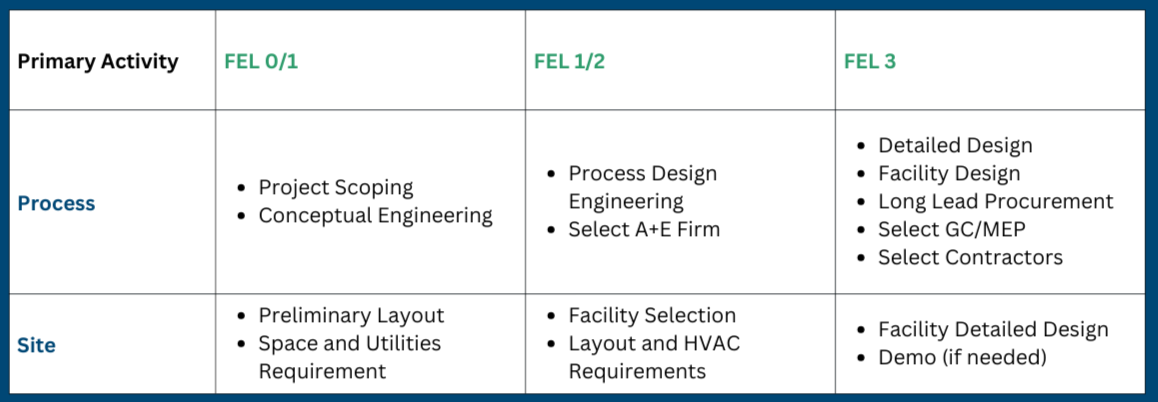
Table: FEL Stage Overview: Follow the FEL stages diligently to ensure that all aspects of the project are thoroughly planned and executed, minimizing risks and maximizing success:
What’s Next
In the next installment of our Baker’s Dozen series, we’ll explore how to bring your design to life efficiently and effectively. Stay tuned for insights into aligning your team and resources for seamless project delivery!
Ready for your free consultation? Let’s talk!
The earlier we start the conversation, the stronger your foundation will be.
Fill out the form below to get started.